
August 17, 2026
Wellness Tips
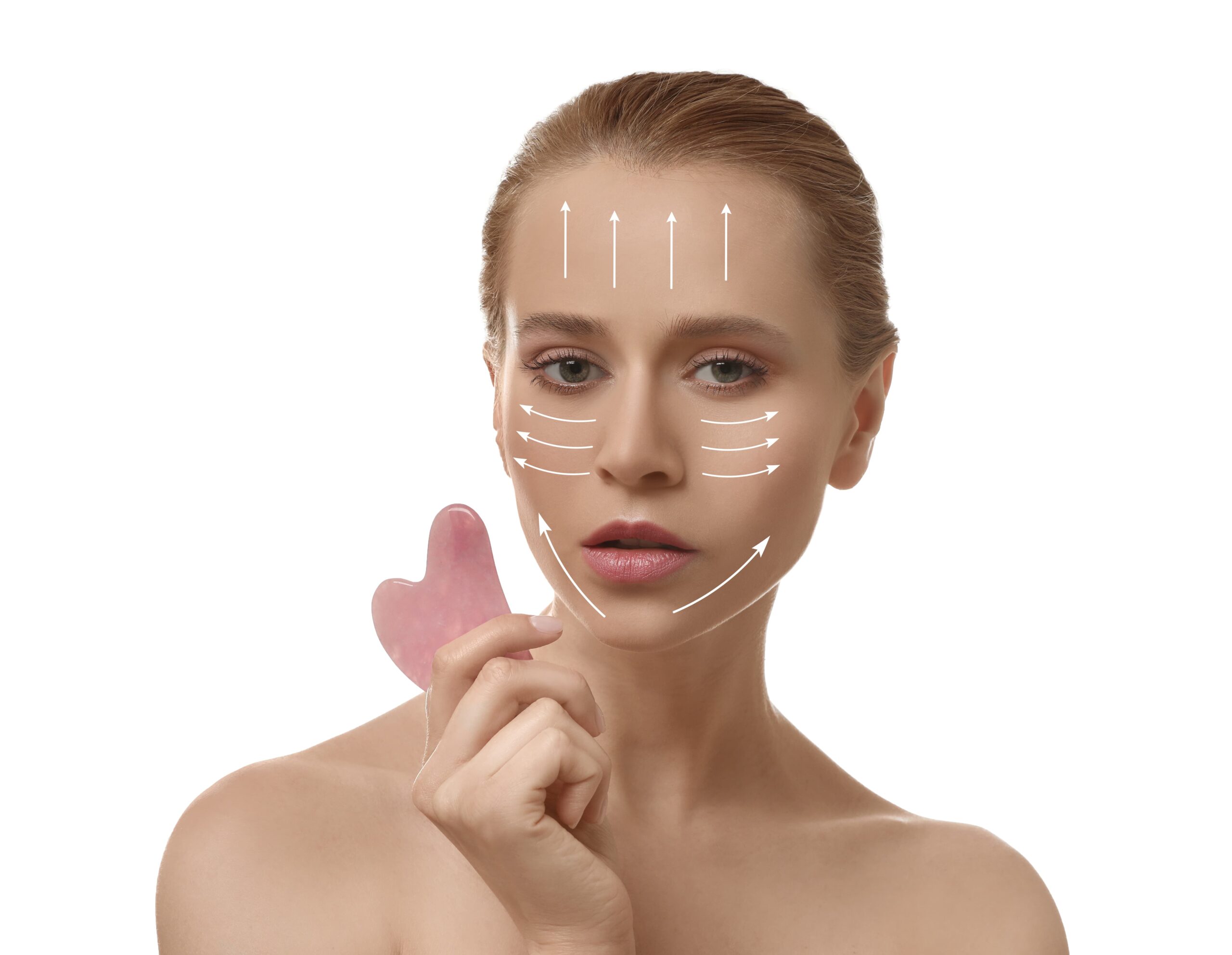
A gua sha routine is a facial massage sequence performed with a smooth-edged stone tool. You apply oil, then draw the tool across the skin in upward and outward strokes, starting at the neck and finishing at the forehead. A full sequence takes about 10 minutes and follows the direction of lymphatic flow.
That order matters more than most people realise. Working from the forehead down traps fluid rather than moving it. Everything below assumes you start at the neck.
What You Need Before You Start
Three things, and only one of them is the tool.
- A gua sha stone: Jade, rose quartz, bian stone, or stainless steel. The material matters less than the shape: you want at least one long flat edge and one notched or curved edge.
- Facial oil or a slip serum: This is not optional. Dragging a stone across dry skin causes friction and irritation. If oil breaks you out, a hydrating serum or gel with enough slip works.
- Clean skin, clean hands, clean tool: Gua sha pushes whatever is on the surface into the skin, so anything left over from the day goes with it.
The 10-Minute Gua Sha Routine
This sequence follows the protocol used in a 2025 randomised controlled trial published in the Journal of Cosmetic Dermatology, where 34 women performed 10-minute sessions five times a week for eight weeks. Using the trial’s own order keeps the routine consistent with something that was actually measured.
Step 1. Prepare the neck and shoulders
Start below the face. Draw the flat edge from the top of the shoulder up the side of the neck, then down toward the collarbone. Three to five passes each side. This opens the drainage path everything else will empty into.
Step 2. Release the lymph nodes and jaw muscles
Using your fingers or the flat of the stone, apply light circular pressure in front of and behind the ears, where the jaw meets the neck. Five to ten seconds. Skipping this step is the single most common reason a routine feels like it does nothing.
Step 3. Chin to ears
Place the notched edge at the centre of the chin and sweep along the jawline to the earlobe. Repeat three to five times per side. This is the stroke people are looking for when they search for jawline definition.
Step 4. Chin to ears, then down the neck
Repeat the jawline stroke, but continue past the ear and down the side of the neck in one motion. This carries fluid out rather than parking it at the ear.
Step 5. Cheeks to temples
Set the long edge beside the nose and sweep up and out toward the temple, stopping short of the hairline. Three to five passes per side. Lighter pressure here than on the jaw.
Step 6. Forehead and brow line
Work outward along the eyebrow line first, then sweep the long edge from the brows up toward the hairline. Finish with gentle pressure held at both temples.
For the under-eye area, use the smallest curve of the notched edge and the lightest pressure you can manage, sweeping from the inner corner outward. The skin here is thinner than anywhere else on the face.
Angle and Pressure by Zone
Holding the tool flat against the skin is the most frequent technique error. The edge should meet the skin at roughly 30 to 45 degrees.
| Zone | Tool edge | Pressure | Direction |
|---|---|---|---|
| Neck | Long flat edge | Medium | Collarbone toward earlobe |
| Jawline | Notched edge | Medium to firm | Chin toward earlobe |
| Cheeks | Long flat edge | Light to medium | Nose toward temple |
| Under-eye | Small curve | Very light | Inner corner outward |
| Brow line | Notched edge | Light | Centre toward hairline |
| Forehead | Long flat edge | Light to medium | Brows toward hairline |
The trial gave participants a useful benchmark for pressure: firm enough to grip and move the surface tissue, but never firm enough to cause discomfort or bruising. Facial gua sha should not raise the red marks associated with body gua sha.
How Often to Repeat It
The trial protocol used five sessions per week for eight weeks, which sits at the higher end of common practice. Many people see benefit at two to three sessions a week, and daily practice is generally considered safe on the face when pressure stays light and the skin is well lubricated.
What matters more than the number is consistency across weeks rather than intensity in any single session. Facial contour changes in the trial were measured at the eight-week mark, not after one use.
For a fuller breakdown of frequency by skin type and goal, see our guide on how often to use gua sha. If you want to know when visible changes typically appear, our gua sha results timeline covers that separately.
Gua Sha vs. Face Roller: What the Research Found
These tools are often sold together and treated as interchangeable. A 2025 randomised controlled trial suggests they are not.
Researchers randomly assigned 34 women aged 20 to 50 to either gua sha or a facial roller, using the same dual-sided tool so the material was identical across both groups. Participants massaged for 10 minutes, five times a week, for eight weeks. Facial contours were measured with a 3D scanner, muscle tone with a myotonometer, and skin elasticity with a cutometer.
Both tools reduced facial surface distances by enough to be visible. The mechanisms differed.
| Measure | Gua sha | Face roller |
|---|---|---|
| Facial contour reduction | 2.23 to 2.40 mm | 2.75 to 3.26 mm |
| Masseter muscle tone | Reduced by 2.02 Hz (significant) | No significant change |
| Muscle stiffness | Reduced by 56.46 N/m (significant) | No significant change |
| Skin elasticity (R2) | No significant change | Improved 8.6% |
| Works primarily on | Muscle and deeper tissue | Superficial skin |
The practical read: if your concern is a tight, clenched jaw or facial tension, gua sha is the better-matched tool. If your concern is surface laxity and elasticity, a roller performed better. The study authors suggested the two may work well in sequence rather than as substitutes.
Separately, a 2007 study using laser Doppler imaging found gua sha increased surface microcirculation by up to 400%, with elevated circulation sustained for more than 25 minutes after treatment. That study was performed on body tissue in 11 healthy subjects, which is worth knowing before extrapolating it to the face. We cover the circulatory mechanism in more depth in our article on gua sha and blood circulation.
Sources: Ahn et al., 2025 randomised controlled trial and Nielsen et al., 2007 microcirculation study.
When to Skip Gua Sha
Facial gua sha is low risk for most people, but there are clear situations to avoid it or check first.
- Active breakouts, eczema, rosacea, or broken skin: The 2025 trial excluded participants with eczema, severe acne, or rosacea. Dragging a tool across inflamed skin spreads bacteria and worsens irritation.
- Recent injectables: Wait until your provider clears you. Timing varies by product and practitioner, so ask the person who treated you rather than following a general rule.
- Blood thinners or a clotting disorder: Speak to your doctor first.
- Pregnancy: The trial excluded pregnant and lactating participants. Check with your provider.
- A known allergy to the tool material: Jade and rose quartz sensitivities are uncommon but documented.
If you have an active skin condition, this is a conversation for a professional before a purchase.
Four Mistakes That Undo the Routine
- Working downward: Strokes should follow lymphatic flow upward and outward. Starting at the forehead moves fluid the wrong way.
- No slip: Skipping oil turns a massage into friction.
- Holding the tool flat: At 90 degrees you are pushing, not gripping. Aim for 30 to 45 degrees.
- Skipping the neck: If you have not opened the drainage path, everything you move on the face has nowhere to go.
At Home or In the Treatment Room
A home routine and a professional Gua Sha Facial are doing related but different jobs. At home, you are maintaining. In a treatment room, a therapist can reach the depth and angles that are awkward to reach on yourself, and can adjust pressure across the masseter and along the neck in ways that are difficult to self-administer.
At Empower Wellness Spa in Encino, the Gua Sha Facial combines traditional gua sha sculpting with skin revitalisation, and each session begins with a consultation to understand what you are working on. It is often chosen by clients dealing with TMJ, headaches, or sluggish lymph flow. Some clients pair it with red light therapy, which we cover in our guide to the gua sha and red light routine.
Book a Gua Sha Facial in Encino. Each session starts with a consultation so the pressure and focus areas are matched to what you are working on, whether that is jaw tension, puffiness, or sluggish lymph flow. Call (818) 208-9052 or email info@empowerwellnessspa.com. We are at 16101 Ventura Blvd, Suite 130, Encino, CA 91436, open Monday to Friday 10:00 AM to 7:00 PM and Saturday to Sunday 10:00 AM to 4:00 PM.
Not ready to book? Have a look at client before and after results first.
Frequently Asked Questions
About 10 minutes for a full face and neck sequence. The 2025 clinical trial standardised sessions at 10 minutes. Shorter targeted sessions on a single area, such as the jawline, can run three to five minutes.
Both work, for different reasons. Morning sessions address overnight puffiness. Evening sessions release muscle tension built up during the day, particularly in the jaw. If you clench or grind, evening is the more useful slot.
You need slip, not specifically oil. A facial oil, a slip serum, or a rich moisturiser with enough glide all work. Oil is preferred because it stays workable longer. If you are acne-prone, a hydrating serum avoids the added occlusion.
Wash with warm water and a gentle soap after each use, then dry it fully. Residual oil goes rancid on the stone and gets reapplied to your face on the next session.
Gua sha reduced facial surface distances by 2.23 to 2.40 mm over eight weeks in the 2025 trial, including at the jawline, and significantly reduced masseter muscle tone. It works on fluid retention and muscle tension. It does not remove fat, so results depend on what is causing the appearance in the first place.
You will often see a short-term de-puffing effect immediately, driven by fluid movement. The measurable contour changes in the trial were recorded after eight weeks of consistent use.
Encino spa, rebounder therapy, red light therapy, wellness recovery